Facebook – E-commerce – 3,132 orders, ROAS 7.20+ and CPA $3.20 over a 3-month period 📈

3,123 purchases · ROAS 7.20 · CPA $3.20 over 2–3 months
How I revived online sales for a manufacturer of T-shirts, blouses, and sweatshirts and turned the direct e-commerce channel into a significantly more profitable growth engine in Bulgaria and Europe.
1. The Initial Situation
The client is a manufacturer of printed T-shirts, blouses, and sweatshirts that sells both through a distribution network in the European market and via its own e-commerce store in Bulgaria. It is precisely the direct online channel that generates a significantly higher profit margin compared to sales through distributors, making it strategically important for the business.
When I took over the account, the business was experiencing a significant decline in online sales over the past 6 months. Production capacity was not being fully utilised, and Meta campaigns were ineffective under the previous management. This meant not just weaker advertising results, but a real shortfall in capacity utilisation and limited profit in the most important channel for direct sales.
The challenge: restoring sales volume, fully utilising production capacity, and maximising profit through the direct e-commerce channel.
2. Work Process
Analysis and Brief
The work began with an in-depth account audit, product analysis, and assessment of the competitive landscape. The goal was not simply to improve campaigns, but to build a strategy aligned with the client’s actual business logic.
- I identified the strongest product categories—men’s shirts, sweatshirts, and car and motorcycle T-shirts.
- I analysed seasonality by design, as different prints have peaks at different times of the year.
- I took into account the margin structure, where the direct e-commerce channel generates significantly higher profits.
- I set clear KPIs: ROAS 5+ for profitable growth and CPA under $4.50.
Two-Campaign Strategy
I established a structure with two parallel campaigns, each with a clear role. Instead of a single, unified approach, the budget was allocated according to the specific function of each campaign.
Scaling campaign (~50% of the budget): focus on proven product categories, strong creatives, and profitable combinations.
Control campaign (~50% of the budget): aimed at broader market coverage, new customers, and long-term customer base growth.
Creative Approach and Formats
Advantage+ Catalogue Ads proved to be the most effective, but not in their standard form. To increase relevance and CTR, I implemented a series of practical modifications that made the ads more competitive and clearer to the user.
- Custom cover images instead of standard catalogue visuals.
- Dynamic descriptions based on product category and seasonality.
- Relevant sitelinks added for higher trust and better navigation.
- Separate ad sets for men’s shirts, sweatshirts, and automotive, motorcycle, soccer, and music-themed T-shirts.
The strategy also included proactive adaptation of designs to seasonality, with a phased budget allocation for validating new designs and subsequently scaling them upon proven effectiveness.
3. Account Results – Campaign Level
The data has been verified using the Conversion API and by the website administration. The campaigns are active and proactively optimised, with both main structures successfully fulfilling their roles.
HP – Scale achieved a ROAS 7.62 at a CPA $3.04but HP – Spread achieved a ROAS 6.35 at a CPA $3.58This confirmed that the two-campaign model not only works in theory but also effectively balances short-term return on investment with broader customer base growth.
4. Results – Ad Set Level
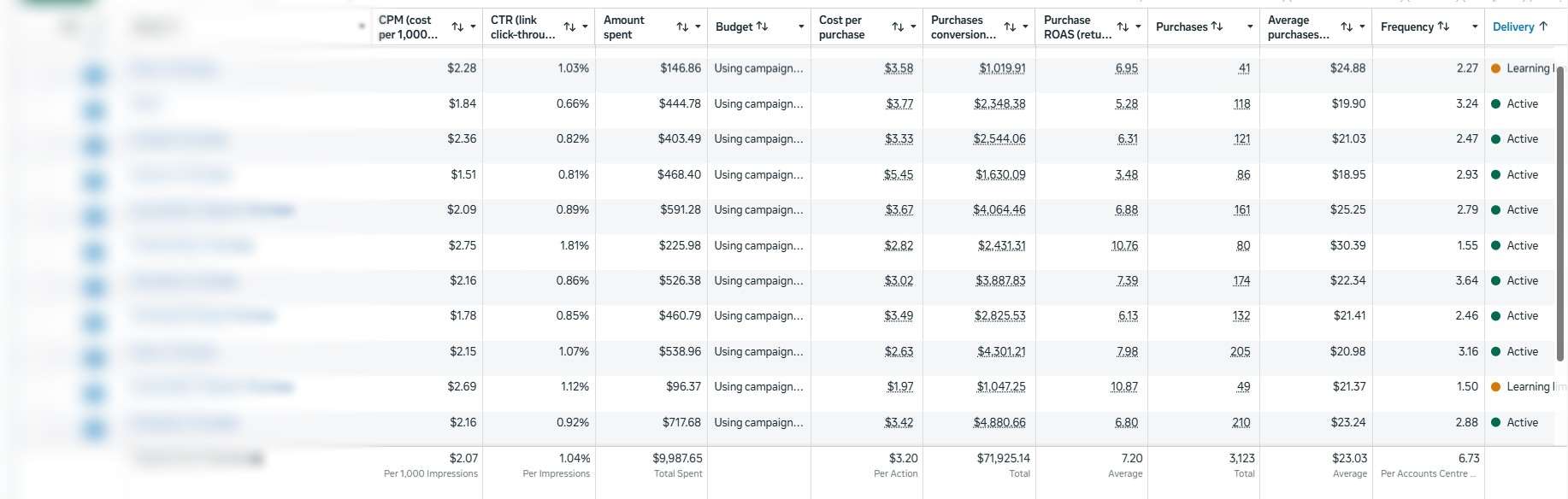
At the ad set level, the structure provided sufficient depth for control and optimisation. A total of 15 active ad sets generated a combined ROAS 7.20 and 3,123 purchases.
Among the strongest performers were TG Adv+Main with ROAS 10.76, F1 Motor Racing with ROAS 10.87 and Music with ROAS 7.98This provided clear direction not only for current budgeting but also for future expansion of the catalogue into categories with proven market potential.
5. Results – Ad Level (by Spend)
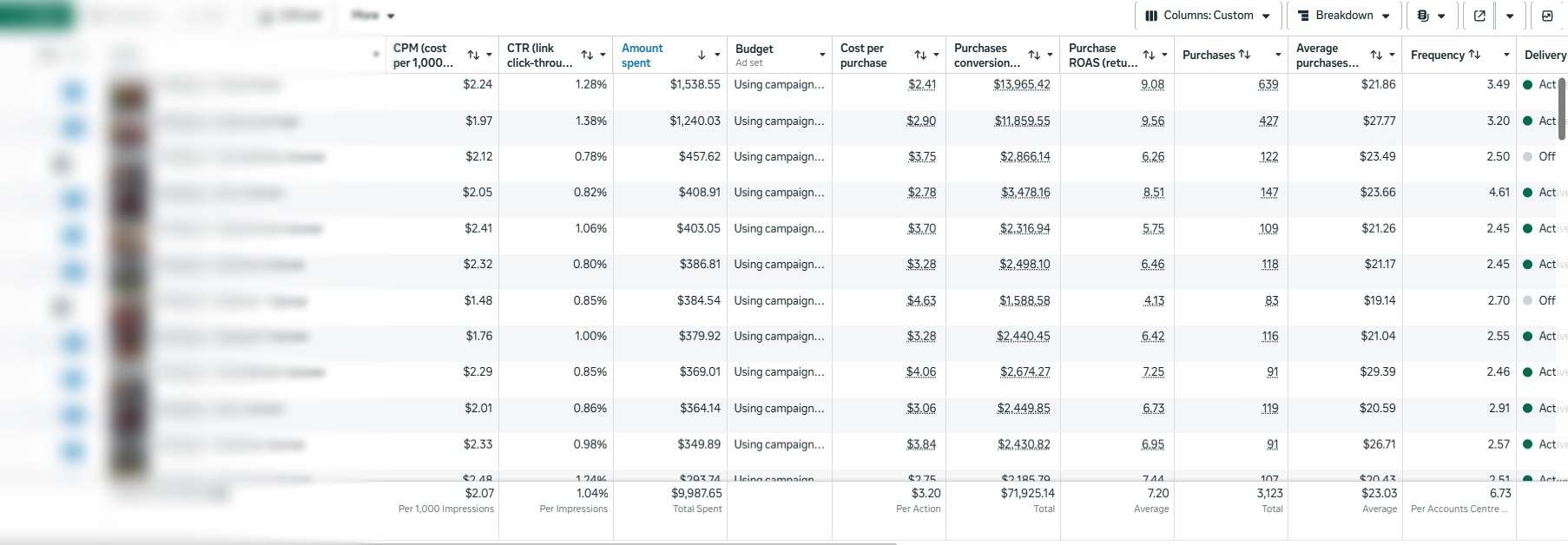
At the ad level, the account ran 66 active adswhich allowed for sufficient creative diversification without spreading the budget too thin. In terms of spend and purchases, the catalogue ads for men’s shirts and men’s sweatshirts performed the strongest.
Catalogue – Men’s Shirts reached $1,538 in spend, 639 purchases and ROAS 9.08but Catalogue – Men’s Sweatshirts achieved a $1,240 in spend, 427 purchases and ROAS 9.56This confirmed that these product lines are key not only for revenue but also for scalable growth.
6. Results – Ad Level (by ROAS)
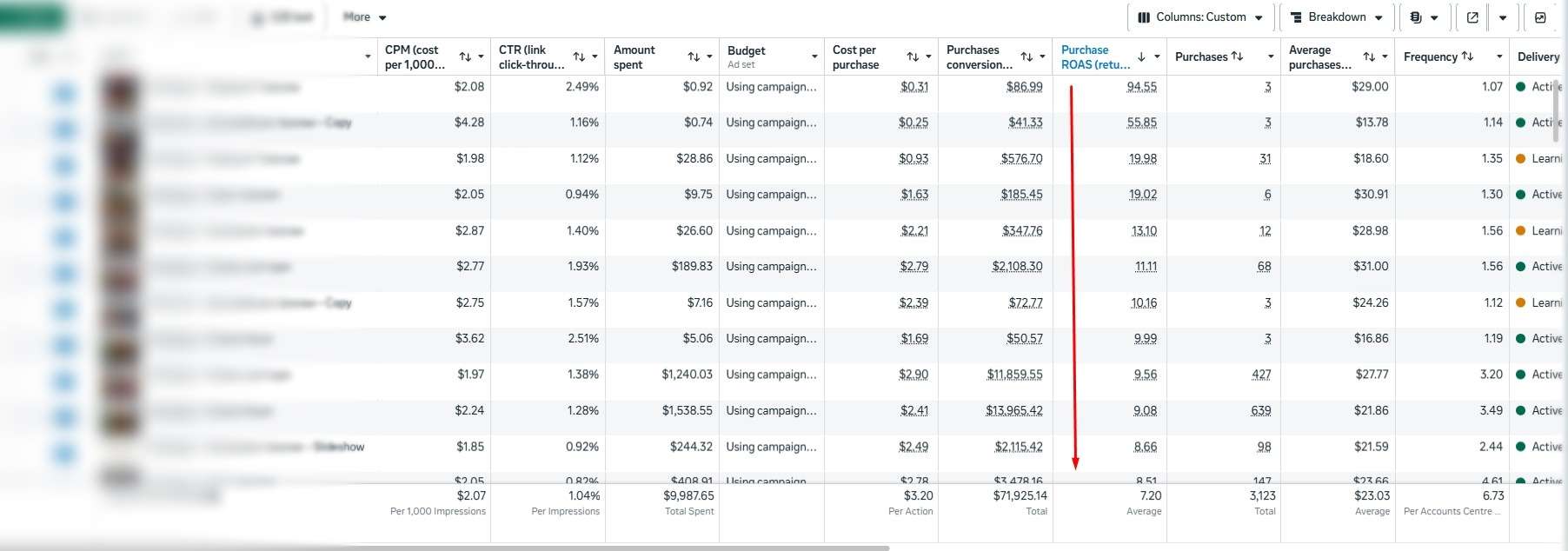
When sorted by return on ad spend, it became clear which specific ad formats and product groups generate the highest profitability. The “Catalogue – Formula 1 T-shirts” reached ROAS 94.55but the “Collection – Automotive T-shirts” achieved a ROAS 55.85.
It is precisely this type of data that enables smarter planning for the next cycle—not just a larger budget, but more precise allocation of the budget to categories and creatives with the highest profit potential.
7. Summary of Results
Within 2–3 months, the business not only recovered its lost sales volume but also rebuilt a predictable and profitable system for direct online growth.
- Production capacity was fully utilised.
- The direct e-commerce channel began generating significantly higher profits compared to the distributor model.
- Advantage+ Catalogue Ads, with the right modifications, proved to be the most effective format.
- The two-campaign structure created a balance between short-term effectiveness and long-term expansion of the customer base.
- Proactive seasonal adaptation allowed for timely scaling of the right designs and categories.
8. Conclusion
The key to success here wasn’t just the technical management of Meta Ads. The real difference came from a deep understanding of the business model, margin structure, product seasonality, and how different categories impact production and profit.
Instead of a cookie-cutter approach, the strategy was built around the client’s real-world context—as a manufacturer that needs to simultaneously maintain volume, utilize capacity effectively, and drive sales toward the more profitable direct channel. This is precisely what led to a result with real business value: restored sales, full capacity, and higher e-commerce profits.
This is an example of how the right strategy, continuous optimisation, and a deep understanding of the business can turn advertising into a real engine of growth, rather than just a source of traffic.
Want similar results for your e-commerce business?
If you’re looking for more than just ad management—a strategy built around your actual profit, product logic, and scalability—contact me.
Contact meBrands that are already achieving their goals