GlowJoyBox — Results in the First Month: ROAS 4.45, Curated UGC, CRO-Driven
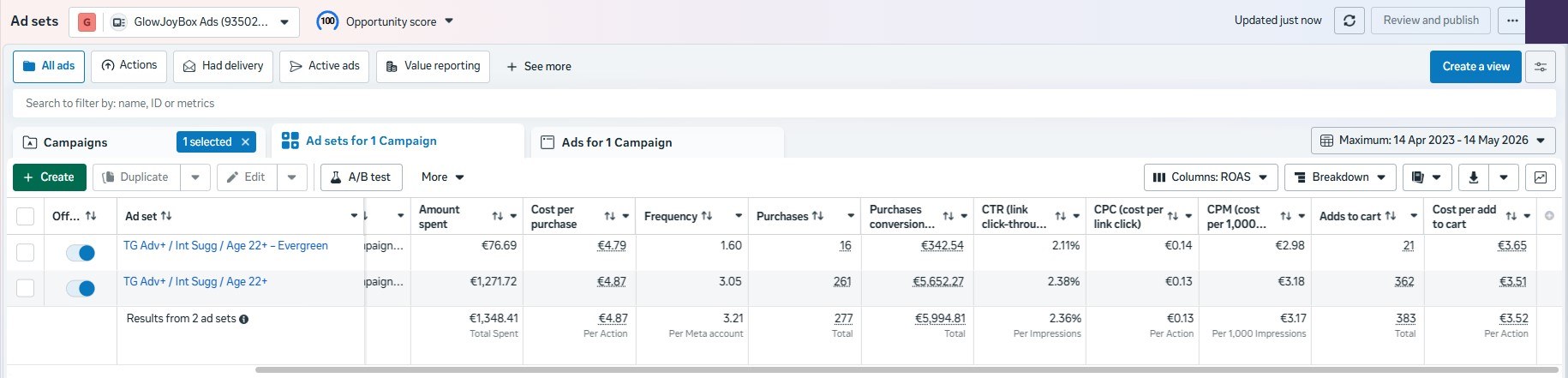
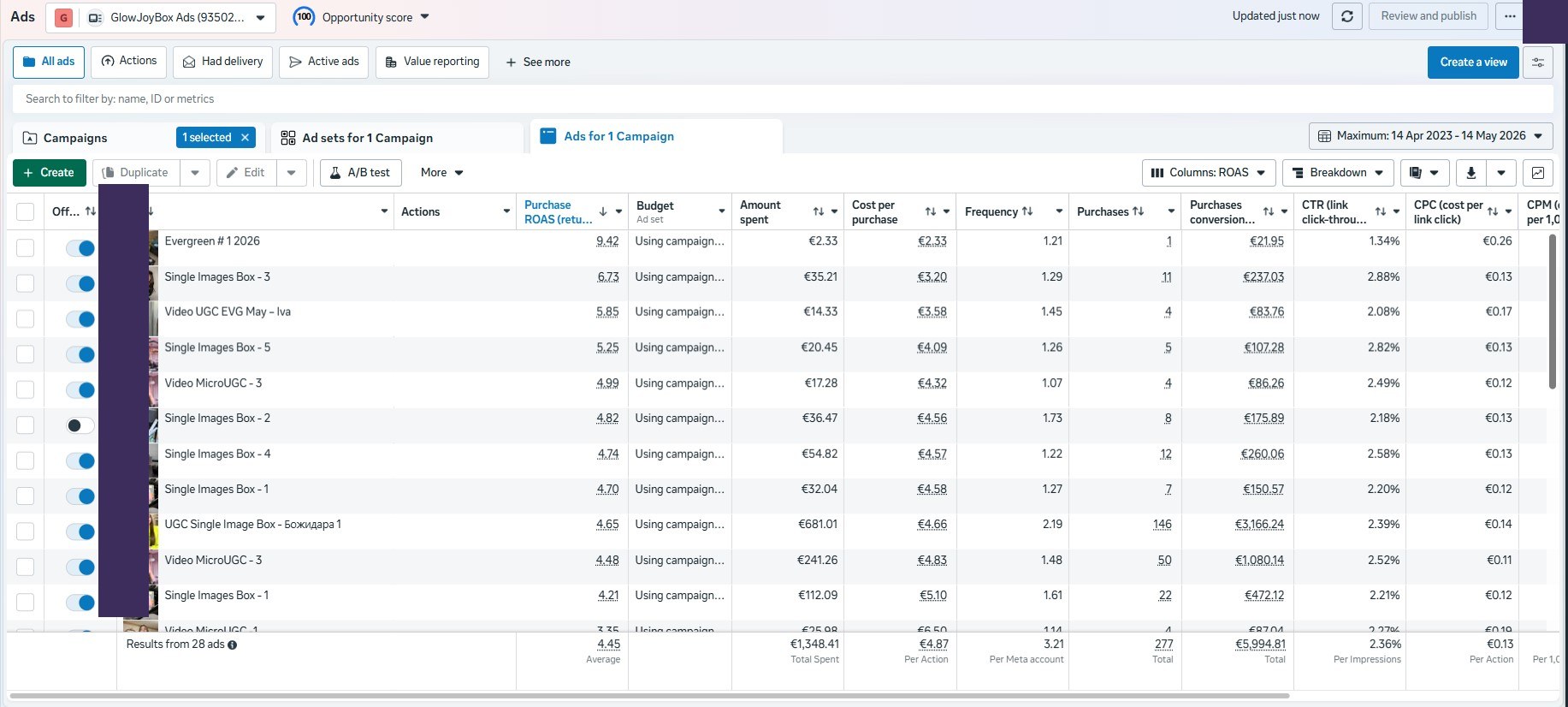
For one month of working together With GlowJoyBox, I completely restructured the Meta Ads account, organized UGC content with influencers, maintained close communication with the brand, and implemented fundamental changes to the website—despite the existing editorial limitations. The result: 277 purchases, €5,994.81 in revenue, average ROAS 4.45, and the top campaign reached ROAS 9.42. A solid foundation for growth, laid in the first 30 days.
What was accomplished in the first month
Audit → Account Restructuring → UGC Organization → CRO Interventions → Scaling
The initial diagnosis revealed a critical situation: a budget of €923, with only €96 (10.4%) allocated to conversion campaigns, while the remaining 89.6% was scattered across traffic, engagement, and awareness campaigns—without a single purchase generated. The message was clear—the product sells when properly optimized; the problem was entirely structural.
Over the course of 30 days, I worked simultaneously on four fronts:
- Restructuring the Meta account — Pause all traffic/engagement/awareness campaigns and consolidate them into the Advantage+ conversion structure with Purchase optimisation.
- Organisation of UGC content — coordinating with influencers, organising unboxing videos, and turning influencer content into effective creative assets for conversion campaigns (not just an "awareness wrapper," as was the case before).
- Enhanced communication with the brand — Weekly updates, quick feedback on creatives and copy, and establishing a workflow.
- Major changes to the website — Despite the editorial limitations imposed by the existing platform, I was able to implement CRO interventions that improve the user experience and the conversion funnel.
This amount of work usually takes 2–3 months at a slower pace. Here, it was completed in 30 days—and the results were already visible by the end of the first month.
What does the account show after the restructuring?
After three weeks in the new structure, the results have stabilised at levels that exceed the original ones more than 2×. The screenshots below are taken directly from Meta Ads Manager.
Before and after — a world of difference
Previously (inherited account)
- 75.4% of the budget spent on traffic campaigns
- 0 purchases from 89.6% of the budget
- ROAS for conversions: 2.02–2.78×
- Average CPP: €8.09
- Awareness + Giveaway without a conversion funnel
- Engagement optimization skews the pixel signal
After (new structure)
- 100% budget allocated to conversion campaigns
- 277 purchases during the period
- Average ROAS: 4.45×, top ad: 9.42×
- Average CPP: €4.87 (-40%)
- Pure Advantage+ mix of TG Adv+ / Int Sugg / Age 22+
- UGC + static creatives in the right wrapper
Key Effective Strategies
1. Consolidation into the Advantage+ structure
I paused all traffic, engagement, and awareness campaigns. All activity was redirected to two conversion ad sets optimised for Purchase—one Evergreen and one with broader interest targeting. No fragmentation, no 17 parallel tests.
2. Creative mix: UGC + static content
Vlogger unboxing videos, which initially served as awareness campaigns, were moved to the appropriate context—a conversion campaign optimised for purchases. Complemented by single-image creatives featuring the boxes themselves, they achieved a ROAS of 6.73×.
3. Frequency control
An average frequency of 3.21 for the period—a healthy level for a subscription box product, well below the levels of audience exhaustion (5–6+), at which ROAS begins to drop sharply.
4. Controlled scaling
4. Controlled: The budget was gradually increased on ad sets that were proven to be effective, rather than by launching new campaigns that would interfere with the learning process. Result: Every €1 of new budget continued to generate €4+ in revenue.
The foundation for long-term growth has been laid
The first month not only yielded results—it laid a solid foundation for everything that followed. The account has been operating smoothly with frequency 3.21, well below the threshold for audience exhaustion. This means there is still room to increase the budget for the same ad sets before it becomes necessary to expand the audience.
The next steps in the plan: Add a retargeting layer for visitors to /products/box and Add to Cart, testing new UGC videos from additional influencers, and Implementation of the Conversion API via Stape to provide a more reliable signal to the algorithm in the face of iOS restrictions and ad blockers.
Conclusions
- Onboarding and stabilisation usually take 2–3 months — but with the right diagnosis and focused execution, the first tangible results can appear as early as the first month.
- Traffic campaigns are not a “cheaper path to sales.” They are a path to clicks. Nothing more.
- Engagement and Giveaway campaigns distort the pixel signal — the algorithm trains on the wrong audience.
- Influencer videos work — but in a conversion campaign, not in an awareness wrapper.
- Scaling is a discipline, not aggression — increasing the budget for ad sets that have proven to work yields more stable results than launching new experiments.