
Case Study · Google Ads · E-commerce
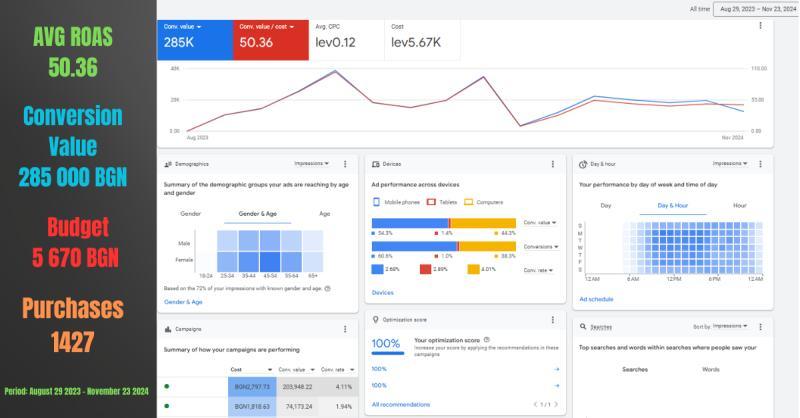
BGN 285,000 in turnover with an average ROAS of 50 from Google Search
An established Bulgarian brand with a virtually unrivalled product — transformed into a profitable Google Search channel through a structure focused on acquiring new customers, beyond brand-related traffic.
Starting point
The client runs a brand that is very well known in Bulgaria, which manufactures exceptionally high-quality and sought-after products that are virtually unrivalled on the market. The work began in accordance with the established process: audit → communication → plan and strategy → implementation — starting with an audit of the brand’s digital activities, product range, main competitors and available investment capital.
The approach — step by step
Audit and consultancy
I immediately recognised the exceptional potential and genuine demand for the products. A brand with a high level of trust and strong market demand.
Channel selection
Google — based on a monthly search volume of over 10,000 and low competition in the auction at that time. Planned expansion into Display, PMax and Shopping for Europe.
Fundamentals and Structure
I went with Google Search. This isn’t a brand campaign — over 70% of the conversions come from new customers, meaning genuine growth beyond repeat orders from existing customers.
Execution
A structure focused on products with the highest purchase intent and actual margin. Result: an average ROAS of around 50, with a steady flow of new customers.
The strategy behind the figure — beyond ad delivery
Results on this scale do not come from fine-tuning campaigns. They come from decisions taken before whether the advertising campaign should go ahead at all — which products are worth investing in and which are not.
At the time of the audit, the brand had several product lines. An analysis of demand, margins and market behaviour clearly showed that only one of them has real potential for profitable online advertising — high intent, strong demand, healthy margins. The other product lines did not perform well in the digital auction: the cost per acquisition made them unprofitable online.
Instead of spreading the budget evenly across the entire catalogue — an approach that drags down the return on investment — I focused my advertising budget on the profitable product line, and as for the other products, I recommended and supported them redirection to offline channels, where they performed significantly better. This meant that every lev invested in Google was put to work where it generated the maximum profit, whilst products unsuitable for the online market did not drain capital.
Capital goes where it makes a profit
One product line accounted for the entire advertising budget — because the data showed that it was the only one that was profitable online. This is a focus, not a limitation.
The right channel for every product
Products that weren’t performing well online were redirected to offline channels, where they generated actual sales — rather than wasting the budget on an unsuitable auction.
Why a ROAS of 50 is no fluke
The right channel for the right moment
Search targets an audience that is already looking for the product. With over 10,000 searches per month and low competition in the auction, every lev invested delivered a low cost per click and high purchase intent.
A structure for new customers, not for the brand
Over 70% of the conversions came from new customers. This isn’t a brand campaign that simply generates ready-made sales — it’s genuine growth in our customer base.
A product with virtually no equivalent
A high-quality, sought-after product with little competition allows for aggressive positioning at a healthy price point — an advantage that the strategy exploits to the full.
Budgetary discipline
The budget was allocated to the products with the highest purchase intent and actual margin, rather than being spread evenly across the entire catalogue — which is why the return on investment remained consistently high.
An ROAS at this level is not a realistic target for every business in Bulgaria — it reflects the scale of the budgets and the maturity of the projects I work on day-to-day. The underlying logic is universally applicable: the right channel, capital directed only where it generates a profit, and constant optimisation of expenditure.
Hristiyan Panov · Founder & Managing Consultant
